


The first Bluetooth 6.2 certification has been issued. 6.0 VS 6.2: How to choose a Bluetooth module ?
On July 4, 2026, Huihan Technology announced that its self-developed Bluetooth protocol stack, FlairBlue, had officially passed the Bluetooth SIG 6.2 core specification certification, becoming the world's first module manufacturer to pass Bluetooth 6.2 certification . Behind this certification lies years of evolution and accumulation in Bluetooth technology. As Bluetooth 6.2 compresses the connection interval from 7.5 milliseconds to 375 microseconds, and as channel detection moves from "meter-level" to "centimeter-level," a real question arises: should Bluetooth modules use 6.0 or 6.2?
For module manufacturers, another more fundamental question arises: should they chase the latest standard version, or strive for excellence in already mature technologies?

I. Bluetooth's "old problems": Why do we always have to put up with latency, dropped connections and inaccurate measurements?
Prior to Bluetooth 6.2, Bluetooth technology had three core pain points that had long plagued the industry:

Pain Point 1: The latency ceiling is too low. The minimum connection interval for Bluetooth Low Energy is fixed at 7.5 milliseconds . For daily office work or leisure, 7.5ms may be acceptable. However, in the competitive world where milliseconds matter—Bluetooth mice deter esports players, and Bluetooth keyboards can never keep up with wired devices in terms of response speed—this is not a problem that software can solve, but a physical bottleneck at the protocol level.
Pain Point Two: Inaccurate Positioning. Traditional Bluetooth positioning relies on Received Signal Strength Indicator (RSSI). However, RSSI signals are highly susceptible to environmental interference—human obstruction, wall reflections, and multipath effects can all cause drastic signal fluctuations. Typical errors are between 3 and 5 meters . Digital car keys "standing still," asset tracking "inaccurate"—these scenarios all stem from the same problem: Bluetooth doesn't know "how far away the device is."
Pain Point 3: Vulnerabilities in Secure Distance Measurement. RSSI cannot defend against relay attacks. Attackers can forge distance information with just a signal amplifier. With the rapid popularization of digital keys and keyless entry systems, distance measurement security has gone from being a "nice-to-have" to a "life-or-death" issue.
These pain points combined have created an awkward reality: Bluetooth connectivity is ubiquitous, but high-end application scenarios—such as e-sports peripherals, digital keys, and industrial positioning—have been hesitant to adopt Bluetooth as their "primary solution."
II. Bluetooth 6.0 vs 6.2: Two "trump cards," two different positioning methods
To answer the question of "choosing 6.0 or 6.2", we first need to clarify the capability boundaries of the two generations of standards.
Bluetooth 6.0 (released in September 2024): Channel detection is the biggest highlight.
The most significant upgrade in Bluetooth 6.0 is its Channel Sounding feature. This technology combines Phase Scale (PBR) and Round Trip Time (RTT) for distance calculation, improving Bluetooth positioning accuracy from meter-level error (RSSI) to centimeter-level . In 2025, shipments of Bluetooth Channel Sounding modules reached 32 million units . The global BLE 6.0 Channel Sounding module market is projected to grow from $21 million in 2024 to $210 million in 2031 , representing a CAGR of 25.0% .
Bluetooth 6.2 (to be released in November 2025): SCI is a decisive upgrade.
Bluetooth 6.2, building upon 6.0, introduces Shorter Connection Interval (SCI) technology. SCI reduces the minimum connection interval for Bluetooth Low Energy from 7.5 milliseconds to 375 microseconds, resulting in a 20-fold increase in response speed . It can achieve a reporting rate exceeding 2 kHz under secure connections . Resolution is refined to 125 microseconds .
Meanwhile, Bluetooth 6.2 includes security enhancements for channel probing—a new attack detection mechanism based on signal amplitude effectively detects and defends against sophisticated relay and spoofing attacks. This enhancement is crucial for automotive, smart home, and industrial applications.
One picture to show the difference:
 Key findings: Bluetooth 6.0 solved the "where" problem (centimeter-level positioning), while Bluetooth 6.2 solved the "how fast" problem (ultra-low latency of 375 microseconds) and the "how secure" problem (attack-resistant ranging). They are not substitutes for each other, but rather optimal solutions for different scenarios.
III. Ofeixin's Choice: Deepening its expertise in Bluetooth 6.0 and becoming a professional player in the "precise positioning" field.
Faced with the industrialization wave of Bluetooth 6.2, Oufexin's strategic choice is pragmatic—focusing on mature versions of Bluetooth 6.0 and below, and maximizing the centimeter-level positioning capability of channel detection.
This choice is based on rational judgment on three levels:
Judgment 1: Bluetooth 6.0's channel detection capability is sufficient to cover more than 95% of current commercial scenarios.
Digital keys, asset tracking, indoor navigation, access control systems—the core requirement for these scenarios is "knowing where the device is," not "how fast the response is." For the vast majority of IoT applications, Bluetooth 6.0's positioning capabilities are already "sufficient," and it is also lower in cost and has a more mature ecosystem.
Judgment 2 : The industrialization of Bluetooth 6.2 still needs time.
The standard was released in November 2025, and the first module certification was issued in July 2026—less than eight months indeed demonstrates the industry's rapid response. However, there is still a considerable distance between "the first certification" and "large-scale commercial use ." The penetration of terminal devices, the maturity of the software environment, and the completion of interoperability verification all require time. Rather than waiting for a standard that is not yet fully mature, it is better to perfect the technology that is already mature.
Key takeaway: Oufexin's decision to focus on Bluetooth 6.0 is not because it "can't keep up," but rather based on a precise assessment of market demand—in the scenario of "precise positioning," the greatest common denominator, Bluetooth 6.0 is already powerful enough, and it is also cheaper, faster to deliver, and has a more mature ecosystem.
IV. Ofeixin Technology: Professional Strength in Bluetooth 6.0 Modules
Qogrisys, a professional wireless communication module supplier, has a deep understanding of the evolution trends of Bluetooth technology in terms of positioning, power consumption and connection stability, and has built a complete module product matrix covering Bluetooth 5.0 to Bluetooth 6.0.
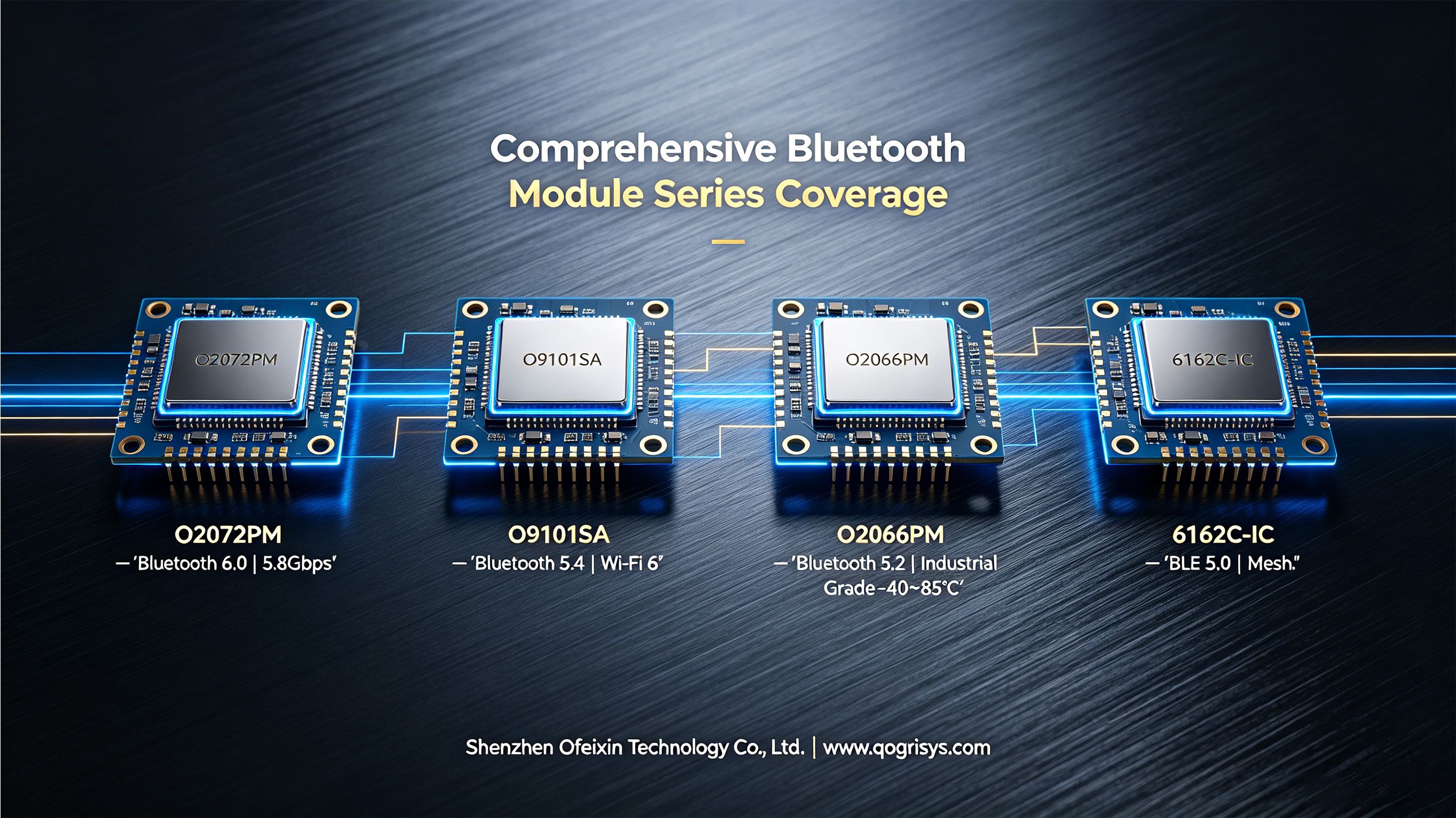
The O2072PM /O2072PB module, based on the Qualcomm QCC2072 chip, supports Bluetooth 6.0 and integrates channel sounding for high-precision distance measurement. The module uses an M.2 Key E standard interface, a 2T2R dual-antenna design, and supports both Wi-Fi and Bluetooth. Peak data rates reach up to 5.8Gbps , supporting 320MHz bandwidth and 4K QAM. It is suitable for scenarios requiring high positioning accuracy, such as digital keys, asset tracking, and smart locks.
O9101SA / O9101UB — A domestically produced dual-mode module for Wi-Fi 6 and Bluetooth 5.4/5.3, supporting simultaneous operation of 2.4GHz and 5GHz dual bands (DBS). Its ultra-small 12×12mm size makes it suitable for IoT devices with limited space.
O2066PM — an industrial-grade Wi-Fi 6 and Bluetooth 5.2 module that supports a wide operating temperature range of -40°C to +85°C , suitable for harsh environments such as industrial automation and smart grids.
6162C-IC / 6161B-R — Low-cost, low-power Bluetooth 5.0 modules. The 6162C-IC supports Mesh functionality, while the 6161B-R supports UART and PCM interfaces.
At the product planning level, Oufexin is closely following the latest evolution of Bluetooth technology . Its Bluetooth module solutions, based on mainstream chip platforms such as Qualcomm and Realtek, possess the technological foundation to evolve to higher versions of the Bluetooth standard. From Bluetooth 5.0 to Bluetooth 6.0, Oufexin's Bluetooth module product line covers all scenarios from classic Bluetooth to Bluetooth Low Energy, from single-mode to dual-mode, and from consumer-grade to industrial-grade applications .
Key takeaway: Aufexin's Bluetooth module matrix covers the entire range from Bluetooth 5.0 to Bluetooth 6.0—whether you need centimeter-level positioning for digital keys, wide-temperature reliability for industrial equipment, or high cost-effectiveness for consumer electronics, Aufexin can provide a matching module solution.
In terms of technical capabilities, Oufexin provides customers with full-process technical support, from module selection, power consumption optimization, antenna design to certification testing . Bluetooth module development involves multiple stages, including RF tuning, protocol stack adaptation, and power management—Oufexin's engineering team has accumulated extensive experience in these areas, enabling them to help customers complete Bluetooth module selection, integration, and certification in the shortest possible time.
V. How to play the two "trump cards"? The scenario determines the choice.
Bluetooth 6.0 and 6.2 each have their own strengths, and the choice depends on the priority of latency, positioning, and security in the application scenario.
Scenarios for choosing Bluetooth 6.0: Positioning is a basic requirement, and latency is not a major concern.
" knowing where the device is." Bluetooth 6.0's channel detection provides centimeter-level positioning accuracy, and related modules shipped reached 32 million units in 2025. If your product requires "location" rather than "speed," Bluetooth 6.0 is currently the most cost-effective choice.
Scenarios where Bluetooth 6.2 is chosen: latency-sensitive, user experience is paramount.
Gaming peripherals (mice, keyboards, gamepads) – a connection interval of 375 microseconds means that 2K+ wireless polling rates are a reality. For the first time, wireless peripherals have truly caught up with the "zero-perceptible" experience of wired connections.
VR/AR headsets – sub-millisecond communication cycles support smoother immersive interaction.
Industrial real-time control – In high-density equipment environments, SCI’s ultra-low latency can significantly improve system response speed.
Human-Computer Interface (HMI) – In scenarios such as smart car cockpits and medical device control panels, every touch a user makes can receive instant feedback .
Key takeaways: If your product prioritizes an "ultimate experience"—e-sports, VR/AR, real-time control—Bluetooth 6.2 is the only correct choice. If your product prioritizes "precise positioning"—digital keys, asset tracking—Bluetooth 6.0 is sufficient, and it's also lower in cost and has a more mature ecosystem.
Qogrisys offers a complete product matrix covering Bluetooth 5.0 to Bluetooth 6.0, along with end-to-end technical support from module selection to system integration. Qogrisys is committed to helping customers quickly upgrade their products and achieve commercialization during the Bluetooth 6.0 era.


